 12, Oct 2026
How Much Should a Professional Website Cost in the US in 2026?
Read More
Starting a new business comes with a long list of priorities. You need customers, visibility, leads, and sales often before you have built a strong reputation or established a steady flow of organic traffic.
That is why many new businesses ask the same question:
Should we invest in Google Ads or SEO first?
Both can bring valuable traffic and support business growth, but they work in very different ways.
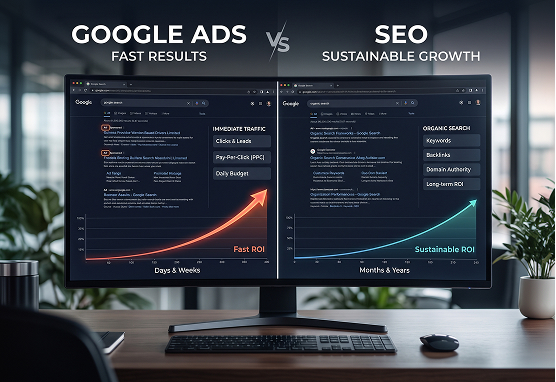
Google Ads can put your business in front of potential customers almost immediately. SEO usually takes longer to build, but can create a steady source of organic traffic without paying for every click.
So, which one gives a faster return on investment?
For most new businesses, Google Ads can produce results faster. But that does not necessarily make it the better long-term strategy.
The right approach often depends on your goals, budget, competition, industry, and how quickly you need customers.
Before comparing the two, it helps to understand how they work.
Google Ads is a paid advertising platform that allows businesses to appear in search results and across Google’s advertising network.
For example, if someone searches:
“emergency plumber near me”
a plumbing company running a relevant Google Ads campaign may appear near the top of the search results.
The business pays when someone interacts with the advertisement, depending on the campaign and bidding model.
This gives businesses the opportunity to reach people who are already searching for a relevant product or service.
Search Engine Optimisation focuses on improving a website’s organic visibility in search results.
Instead of paying Google for each click, businesses improve areas such as:
The goal is to build organic rankings that can continue generating traffic over time.
This is where Google Ads usually has the advantage.
Once a campaign is properly set up, targeted, approved, and launched, ads can begin generating impressions and clicks relatively quickly.
SEO does not usually work that way.
A new website may need weeks or months to start gaining meaningful organic visibility, depending on the industry, competition, website quality, authority, and keywords being targeted.
That does not mean SEO is ineffective.
It means the timeframes are different.
Think of Google Ads as a paid route to immediate visibility, while SEO is an investment in building organic visibility over time.
For a new business, speed can be extremely valuable.
Imagine you have just launched a new cleaning company in New York.
Your website is live, but nobody knows about your business yet.
You could begin publishing content and working on SEO, but it may take time before the website starts ranking for competitive searches.
With Google Ads, you can create campaigns targeting searches such as:
If your campaigns are properly targeted and your ads are competitive, you can begin reaching potential customers much sooner.
This is particularly useful for businesses that need enquiries or sales quickly.
SEO’s biggest advantage is that the work you invest in today can continue producing value in the future.
Imagine a service page eventually reaches a strong organic position for an important search.
That page can potentially generate relevant traffic month after month without paying Google for each individual click.
However, maintaining strong organic visibility still requires ongoing work.
Competitors can improve their websites. Search behaviour can change. Google can update its systems. Content can become outdated.
SEO is therefore not simply a one-time project.
It is a long-term marketing channel.
Google Ads does not have one fixed price.
The cost can vary significantly depending on:
A highly competitive industry can have significantly higher click costs than a less competitive market.
This means simply setting a daily budget does not guarantee profitable results.
You also need to consider what happens after someone clicks.
If you pay $10 for a click but the landing page does not generate enquiries or sales, the campaign is not necessarily successful.
SEO also varies in cost.
A new business with a small website may need a very different SEO strategy from a national e-commerce company with thousands of products.
The important thing is to look at SEO as an investment in organic visibility rather than simply a monthly expense.
There is no universal answer.
ROI depends on the economics of your business.
Consider a company that sells a service worth $2,000.
If a well-managed Google Ads campaign generates a customer for $150 in advertising costs, the economics may work very well.
But consider a business selling a $20 product with a very small profit margin.
The same advertising cost may not make sense.
SEO can have a different cost structure because you are investing in the website, content, technical improvements, and overall organic visibility rather than paying for every individual visitor.
The right question is not:
“Is Google Ads better than SEO?”
It is:
“Which channel makes financial sense for our business and customer acquisition goals?”
Google Ads may be particularly useful when:
If you have just launched and need enquiries immediately, waiting several months for organic visibility may not be practical.
Some searches show clear buying intent.
For example:
“emergency dentist open now”
has a very different intent from:
“how to prevent tooth decay.”
Google Ads can help businesses reach users closer to taking action.
Paid traffic works better when there is a clear reason for people to choose your business.
That could be:
If you know which campaigns, keywords, and ads are generating leads or sales, you can make better decisions about where to invest.
SEO can be especially valuable when:
Businesses that want to build a long-term source of website traffic can benefit from investing in organic visibility.
Some industries have longer decision-making processes.
Customers may read articles, compare providers, research pricing, and look at reviews before contacting a business.
Useful organic content can help you stay visible throughout that process.
If your industry has expensive and highly competitive keywords, building organic visibility can provide another route to relevant traffic.
SEO generally works best when treated as an ongoing investment rather than a quick campaign.
The biggest mistake is treating Google Ads and SEO as completely separate choices.
They can support each other.
For example, a new business could use Google Ads to generate traffic and enquiries while simultaneously building its organic search presence.
The paid campaign can provide useful information about:
That information can then help inform the wider SEO strategy.
One of the advantages of paid search is that it can provide relatively quick feedback.
Suppose you are unsure whether customers are more interested in:
“corporate event catering”
or
“office lunch catering.”
Instead of relying entirely on assumptions, a well-structured campaign can help you understand which searches generate meaningful engagement and conversions.
That does not mean every Google Ads result should automatically become an SEO target.
But paid search data can provide useful insight into customer behaviour.
If every visitor to your website comes through paid advertising, stopping your campaigns can cause traffic to fall quickly.
Organic search can provide another source of visibility.
This does not mean businesses should stop advertising once they rank organically.
In many cases, paid and organic listings can work together to increase overall search visibility.
The goal is to build a more balanced acquisition strategy.
If your business has a limited marketing budget, start by identifying your immediate priority.
Consider starting with Google Ads.
Build a focused campaign around your highest-value products or services rather than trying to advertise everything at once.
Investing in SEO from the beginning can help establish a strong organic foundation.
Start with:
Use a combination.
A new business can use paid advertising to generate short-term demand while building SEO for longer-term visibility.
If you are looking for a PPC agency in the USA, do not judge an agency only by how quickly it can launch a campaign.
Ask how it will:
A good Google Ads agency USA should be able to explain not just how much traffic the campaign generated, but whether that traffic contributed to leads, sales, bookings, or another meaningful business outcome.
Search Engine Marketing, or SEM, generally refers to marketing through search engines and can include paid search activity.
For businesses exploring SEM services USA, the focus should not simply be on generating more clicks.
The strategy should connect:
Search → Ad → Landing Page → Conversion → Customer
Every part of that journey matters.
A high click-through rate does not mean much if visitors leave without taking action.
For a brand-new business looking for immediate visibility, Google Ads usually has the advantage in speed.
For a business building a long-term source of organic traffic, SEO offers a valuable long-term opportunity.
For many businesses, the strongest strategy is not choosing one over the other.
It is using paid search to capture immediate demand while building organic visibility that can support future growth.