 12, Oct 2026
How Much Should a Professional Website Cost in the US in 2026?
Read More
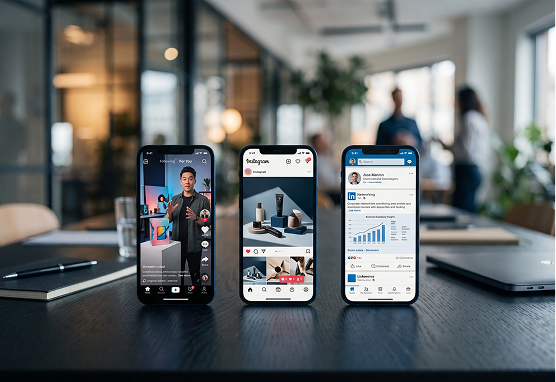
One of the biggest mistakes businesses make on social media is trying to be everywhere at once.
Creating accounts on every major platform may seem like a good way to increase visibility, but it can quickly become difficult to maintain. Different platforms attract different audiences, support different types of content, and work better for different business goals.
For most businesses, the better approach is to identify where their customers actually spend time and build a strong presence there.
TikTok, Instagram and LinkedIn can all be valuable, but they are not interchangeable.
So, which platform is right for your business?
TikTok has become an important platform for businesses that can communicate their products, services or ideas through short-form video.
The platform is particularly useful for brands that want to reach new audiences through entertaining, educational or personality-driven content.
Unlike platforms where users primarily follow established accounts, TikTok can give businesses opportunities to reach people who do not already follow them.
This makes it particularly interesting for brands focused on discovery.
TikTok is a natural fit for content such as:
The content does not always need to look highly produced.
In many cases, content that feels natural and relevant can perform better than advertising that feels overly polished.
TikTok can work particularly well for:
That does not mean B2B companies cannot use TikTok.
It simply means the business needs to find a content format that makes sense for the platform and audience.
Instagram is a strong platform for businesses that rely on visual communication.
It allows brands to combine several content formats, including:
This makes Instagram particularly useful for businesses that need to show what they offer while also building a recognisable brand.
For example, a hotel can use Instagram to showcase rooms, food, experiences and guest moments.
A jewellery brand can highlight products through photography, Reels and styling content.
A service business can use educational posts to demonstrate expertise and answer common customer questions.
Instagram sits somewhere between discovery and relationship building.
A person may discover a brand through a Reel, visit its profile, browse previous posts, check reviews or tagged content, and eventually become a customer.
That means the entire profile matters.
Your bio, visual identity, content, captions, Highlights and overall consistency all contribute to how people perceive the business.
LinkedIn is built around professional relationships, making it particularly valuable for B2B businesses and companies selling professional services.
It can help businesses reach:
The content approach is also different from Instagram and TikTok.
While visual content can still work, LinkedIn is often better suited to ideas, expertise, business insights and professional stories.
Businesses can create content around:
A software company, consulting firm or professional services business may find LinkedIn far more relevant than TikTok.
The right platform depends on what you want to achieve.
| Platform | Strongest For | Content Style | Suitable For |
| TikTok | Discovery and reach | Short-form video | Consumer brands, lifestyle, entertainment |
| Brand building and engagement | Reels, Stories, carousels, images | Consumer and visual brands | |
| B2B visibility and authority | Insights, articles, professional content | B2B and professional services |
These are broad guidelines rather than strict rules.
A business can succeed on an unexpected platform if its audience and content strategy are right.
A platform having millions of users does not automatically mean it is right for your business.
Imagine you run a specialist accounting firm.
You might see a business competitor receiving strong engagement on TikTok and assume you should copy the same approach.
But if your potential clients spend more time researching professional services through LinkedIn, Google and industry networks, TikTok may not be your highest priority.
The goal is not to collect followers.
The goal is to reach the people who are most likely to become customers.
Start by understanding your customers.
Ask:
Who are they?
What do they care about?
What type of content do they consume?
Where are they most likely to discover businesses like mine?
What influences their buying decision?
For example, a fashion retailer targeting younger consumers may benefit from TikTok and Instagram.
A recruitment consultancy may find LinkedIn more valuable.
A restaurant may use Instagram for visual content while also using TikTok to reach new local audiences.
Your business should also consider what type of content it can realistically produce.
If your team is comfortable creating short videos, TikTok and Instagram Reels may be strong options.
If your business has strong industry knowledge, LinkedIn may give you more opportunities to turn that expertise into content.
If your products are highly visual, Instagram may be particularly valuable.
The best platform is often the one where your business can consistently create useful content for the right audience.
Being active on three platforms is not automatically better than doing one platform well.
A small business with limited resources may be better off creating:
than trying to create:
without having enough time to maintain quality.
Consistency matters.
If your business cannot realistically maintain a platform, it may be better to prioritise the channels that matter most.
Repurposing content can save time, but copying the exact same post across every platform is not always the best approach.
The core idea can stay the same while the execution changes.
For example, a business could create one customer success story and adapt it into:
TikTok: A short video explaining the customer’s problem and result.
Instagram: A Reel or carousel showing the story visually.
LinkedIn: A detailed post explaining the business lesson behind the result.
The idea is consistent, but the format fits the platform.
A strong social media strategy should begin with the business objective rather than the platform.
For example:
Goal: Generate more enquiries.
Then determine:
Audience: Who are the potential customers?
Platform: Where do they spend time?
Content: What information or message will attract them?
Call To Action: What should they do next?
Measurement: How will we know whether it worked?
This approach creates a strategy rather than simply a content calendar.
Using multiple platforms makes sense when there is a clear reason for doing so.
For example, a hotel could use:
Instagram for visual experiences and guest content.
TikTok for discovery and short-form travel content.
LinkedIn for corporate partnerships, recruitment and business updates.
Each platform serves a different purpose.
That is much more effective than publishing the same content everywhere simply because the accounts exist.
Managing multiple social platforms involves much more than publishing posts.
A professional social media agency USA may support businesses with:
The objective should be to build a social presence that supports the wider business strategy.
A strong strategy usually has five basic elements:
Know who you are trying to reach.
Understand why each platform is being used.
Create content regularly without sacrificing quality.
Respond to comments, questions and messages instead of treating social media as a one-way publishing channel.
Track results and adjust the strategy based on what the audience responds to.
There is no universal winner.
Choose TikTok if discovery and short-form video are important to your strategy.
Choose Instagram if visual storytelling, brand building and customer engagement are priorities.
Choose LinkedIn if you are targeting professionals, decision-makers or B2B audiences.
And if your customers are active on more than one platform, you can build a connected strategy across several channels.
The important part is knowing what each platform is expected to achieve.